
The digital commerce spectrum for B2B manufacturers
The portal-versus-ecommerce distinction has always been a useful starting point for B2B manufacturers. It helps simplify a crowded market and gives teams a clearer way to sort through very different types of products.
The challenge is that it works best as a starting point, not the full picture.
In practice, digital commerce for manufacturers sits on a spectrum. On one end is straightforward customer self-service: pricing, availability, reorders, invoices, shipment tracking, and basic online ordering for existing customers. On the other is a more persuasion-driven ecommerce experience built to attract, influence, and convert, with capabilities like product discovery, merchandising, content, personalization, and promotions.
Most manufacturers are not really choosing between two separate worlds. They are choosing where they want to land on that spectrum.
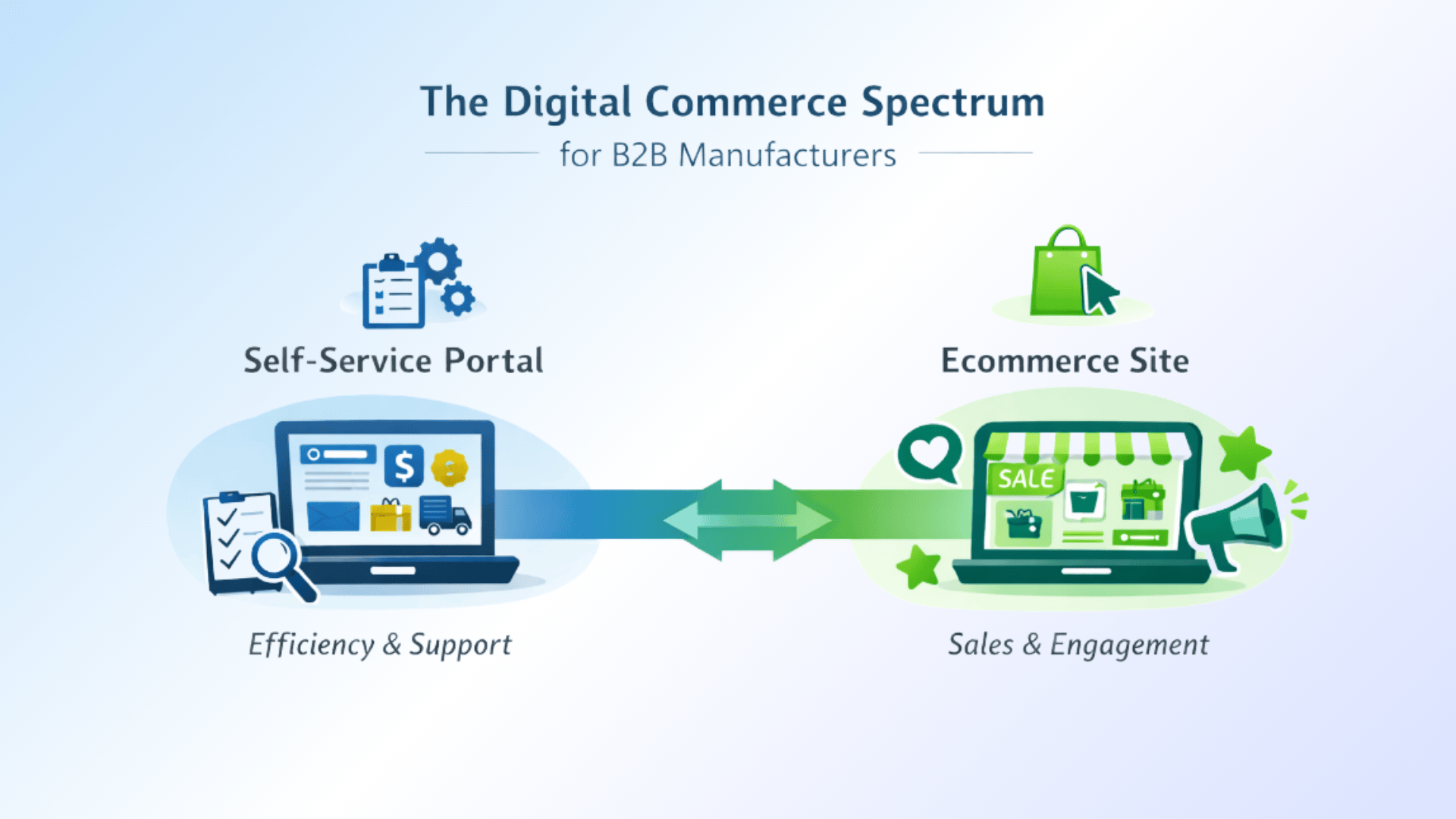
The self-service end: efficiency over persuasion
A helpful way to picture this is the customer service desk at Walmart.
A shopper walks up and asks a simple question: “Is this available, and what’s my price?”
That interaction isn’t about persuading someone to buy. It’s about getting a quick, reliable answer.
For many manufacturers, digital interactions look exactly like that. Customers already know what they need. They’ve negotiated pricing and have a repeat buying pattern. They aren’t looking to be marketed to. They’re looking to get a job done.
That’s what the self-service side of the spectrum supports best: making operational information and transactions instantly accessible online.
Common features include:
- Customer-specific pricing and availability
- Order and invoice lookups
- Shipment tracking and payment history
- Simplified reorder workflows and account support tools
The goal here isn’t to create a high-conversion storefront for anonymous traffic. It’s to make life easier for existing customers, dealers, and internal teams who need answers fast.
Moving toward ecommerce: selling and persuasion
As you move across the spectrum, the digital experience becomes less about service and more about persuasion.
This side focuses on helping users browse, compare, and buy. It prioritizes rich product catalogs, personalized content, merchandising, promotions, recommendations, and branded storefront design.
It’s built to attract and convert, not just transact.
Platforms at this end of the spectrum think SAP Commerce Cloud, Adobe Commerce, or Shopify’s B2B capabilities are optimized for digital storefronts and more complex buying journeys across new and existing customers.
But those extra layers of sophistication come with trade-offs: added cost, complexity, and long-term maintenance.
The middle ground: where many manufacturers live
Many manufacturers don’t live at either extreme. They live in the messy middle.
They want customers to place orders online, but they don’t need a consumer-style shopping journey.
They want a clean catalog and intuitive UX, but not a massive merchandising operation.
They want to reduce manual work and phone calls, but without taking on a platform that requires a full-time digital commerce team.
In this middle space, the right solution looks less like portal only or ecommerce only, and more like a hybrid: self-service access to real ERP data, reliable ordering, and enough catalog and UX polish that customers are comfortable transacting on their own.
That’s where platforms like Corevist tend to sit closer to the self-service side, but with ordering and light catalog experiences that support real digital buying behavior without over-rotating into a heavy marketing stack.
The point isn’t that one specific product is the middle. The point is that there is a middle, and for many manufacturers, that’s the most realistic place to design toward.
Ask the right question: how much persuasion?
For manufacturers evaluating options, the decision framework is simple, but powerful: how much persuasion does your business actually need?
If the answer is not much because most buyers already know what they want and value speed and accuracy, then self-service tools should take priority. The job is to help them move quickly, not to sell them on a decision they’ve effectively already made.
If the goal is to attract new buyers, influence product discovery, and create a branded, digitally driven buying experience, then moving further toward ecommerce makes sense. That’s where richer storefronts, content, and merchandising start to earn their keep.
Every inch you move along that spectrum changes what the platform must deliver and what your team has to manage in return. More persuasion usually means more content, more configuration, and more ongoing decisions about how the experience should work.
That’s why manufacturers should start not with a category label, but with the customer motion they’re trying to support. Are customers coming online to browse and be influenced, or to get answers and get work done?
For most manufacturers, the honest answer lives somewhere in the middle. And that middle is often where digital transformation has the best chance of actually sticking.
