Corevist vs. Sana Commerce
See how Corevist and Sana differ across SAP alignment, platform scope, and digital commerce goals.
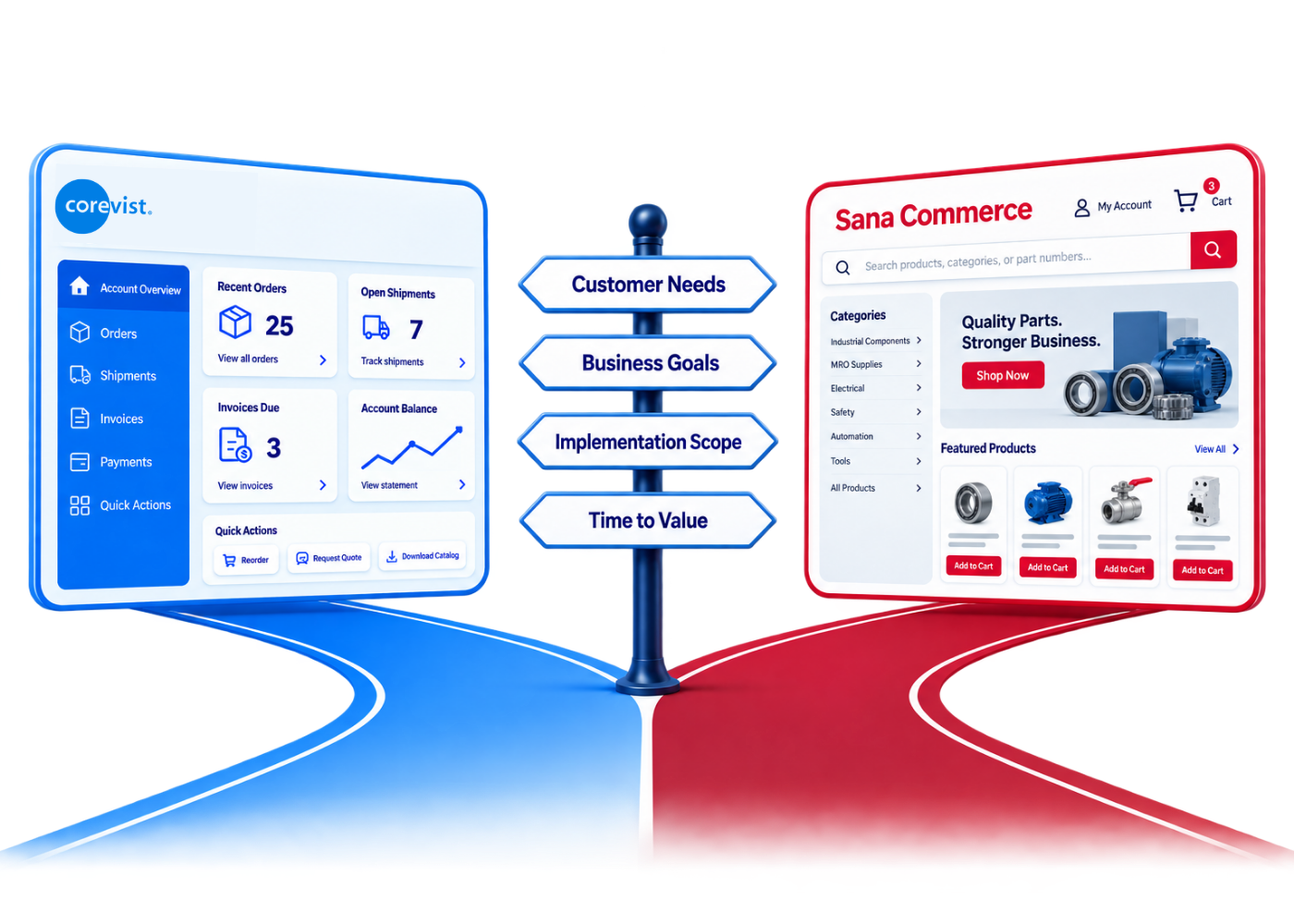
Start with what you want to accomplish.
SAP Depth vs. ERP Breadth
Do you want deep SAP specialization across your current and future SAP environments, or flexibility to support multiple ERPs?
Efficiency vs. Growth
Do you want to streamline service and order management, or use digital commerce as a broader sales and growth channel?
Portal vs. Commerce Suite
Do you want a focused portal for self-service and ordering, or a broader platform for storefront, content, merchandising, and digital selling?
Where Corevist and Sana differ.
Both platforms support SAP-connected B2B buying and self-service. The differences become clearer when you look at their SAP architecture, platform scope, and product direction.
Corevist
Built solely for SAP, with certified integration options across ECC, S/4HANA, and BTP in every package.
Sana
Built for multiple ERPs. For SAP customers, certified integration options vary by package, with broader SAP coverage requiring Sana Advanced.
Corevist
Centers on SAP customer self-service and B2B ordering, including pricing, availability, orders, invoices, payments, account data and other SAP-driven workflows.
Sana
Extends further into storefront management, content, merchandising and broader digital commerce functionality.
Corevist
Product direction stays centered on SAP customer and order workflows, including BTP, clean core and AI-driven order-to-cash automation.
Sana
Product direction is centered more broadly on digital commerce, with SAP integration supporting the commerce experience.
Best fit by use case.
| BEST FIT BY USE CASE | COREVIST ESSENTIAL |
COREVIST PROFESSIONAL |
COREVIST ENTERPRISE |
SANA COMMERCE ADVANCED |
|---|---|---|---|---|
| Order & account visibility | Best fit | More than you need | More than you need | More than you need |
| B2B ordering | Not included | Best fit | More than you need | More than you need |
| Complex B2B requirements & public checkout | Not the focus | Not the focus | Best fit | More than you need |
| Grow revenue through a digital commerce channel | Not the focus | Not the focus | Partial fit | Best fit |
| USE CASE |
CV
ESS.
Corevist Essential
|
CV
PRO
Corevist Professional
|
CV
ENT.
Corevist Enterprise
|
SANA
ADV.
Sana Commerce Advanced
|
|---|---|---|---|---|
| Order & account visibility | Best fit | More than you need | More than you need | More than you need |
| B2B ordering | Not included | Best fit | More than you need | More than you need |
| Complex B2B requirements & public checkout | Not the focus | Not the focus | Best fit | More than you need |
| Grow revenue through a digital commerce channel | Not the focus | Not the focus | Partial fit | Best fit |
This comparison focuses on manufacturers running SAP ECC or S/4HANA. Sana Commerce Essential and Pro are excluded because they support SAP Business One, not SAP ECC or S/4HANA.
Standard capabilities.
| CAPABILITY | COREVIST ESSENTIAL |
COREVIST PROFESSIONAL |
COREVIST ENTERPRISE |
SANA COMMERCE ADVANCED |
|---|---|---|---|---|
| Orders, invoices & shipment visibility | Included | Included | Included | Included |
| Online invoice payment | Included | Included | Included | Included |
| Credit & account information | Included | Included | Included | Included |
| B2B order placement | Not included | Included | Included | Included |
| Customer-specific pricing & availability | Not included | Included | Included | Included |
| Customer-specific catalogs | Not included | Included | Included | Included |
| Quick order / reorder | Not included | Included | Included | Included |
| Quote-to-order | Not included | Included | Included | Included |
| Public catalog & guest checkout | Not included | Not included | Included | Included |
| Multi-country / multi-site rollout | Not included | Not included | Included | Included |
| Advanced merchandising & product discovery | Not included | Not included | Not included | Included |
| CAPABILITY |
CV
ESS.
Corevist Essential
|
CV
PRO
Corevist Professional
|
CV
ENT.
Corevist Enterprise
|
SANA
ADV.
Sana Commerce Advanced
|
|---|---|---|---|---|
| Orders, invoices & shipment visibility | Included | Included | Included | Included |
| Online invoice payment | Included | Included | Included | Included |
| Credit & account information | Included | Included | Included | Included |
| B2B order placement | Not included | Included | Included | Included |
| Customer-specific pricing & availability | Not included | Included | Included | Included |
| Customer-specific catalogs | Not included | Included | Included | Included |
| Quick order / reorder | Not included | Included | Included | Included |
| Quote-to-order | Not included | Included | Included | Included |
| Public catalog & guest checkout | Not included | Not included | Included | Included |
| Multi-country / multi-site rollout | Not included | Not included | Included | Included |
| Advanced merchandising & product discovery | Not included | Not included | Not included | Included |
This comparison focuses on manufacturers running SAP ECC or S/4HANA. Sana Commerce Essential and Pro are excluded because they support SAP Business One, not SAP ECC or S/4HANA.
SAP compatibility & commercial considerations.
| SAP-CERTIFIED INTEGRATION |
SANA ESSENTIAL |
SANA PRO |
SANA ADVANCED |
COREVIST ESSENTIAL |
COREVIST PROFESSIONAL |
COREVIST ENTERPRISE |
|---|---|---|---|---|---|---|
| SAP Business One | Included | Included | Included | Not included | Not included | Not included |
| SAP ECC | Not included | Not included | Included | Included | Included | Included |
| SAP S/4HANA | Not included | Not included | Included | Included | Included | Included |
| SAP BTP | Not included | Not included | Not included | Included | Included | Included |
|
SAP-CERTIFIED INTEGRATION |
SANA
ESS.
Sana Essential
|
SANA
PRO
Sana Pro
|
SANA
ADV.
Sana Advanced
|
CV
ESS.
Corevist Essential
|
CV
PRO
Corevist Professional
|
CV
ENT.
Corevist Enterprise
|
|---|---|---|---|---|---|---|
| SAP Business One | Included | Included | Included | Not included | Not included | Not included |
| SAP ECC | Not included | Not included | Included | Included | Included | Included |
| SAP S/4HANA | Not included | Not included | Included | Included | Included | Included |
| SAP BTP | Not included | Not included | Not included | Included | Included | Included |
FAQs
What’s the difference between Corevist and Sana?
Corevist is an SAP-focused B2B customer portal built around self-service, ordering and live ERP data. Sana Commerce is a broader ecommerce platform with more emphasis on the storefront, merchandising and digital shopping experience.
Does Corevist or Sana have deeper SAP integration?
Corevist is built exclusively for SAP and supports a broader set of SAP integration paths. Sana’s SAP ECC and S/4HANA integrations are available through its Advanced package. If SAP is the center of the project, Corevist is the more SAP-specialized option.
Can customers place orders through both Corevist and Sana?
Yes. Both can support B2B ordering using SAP pricing, availability and customer-specific data.
Do I need full ecommerce to let customers order online?
What's the difference between Corevist Essential and Professional?
Corevist Essential focuses on post-order self-service, including orders, shipments, invoices, payments, account information, and SAP reporting. Corevist Professional adds B2B ordering with customer-specific SAP pricing, ATP availability, catalogs, quick order, reorder, and quote-to-order.
When does Corevist make more sense than Sana?
Corevist tends to fit companies that want to make SAP transactions easier for existing B2B customers without turning the project into a larger ecommerce initiative.
Comparison note:
Sana Commerce and related product names are trademarks of their respective owners. This page is based on publicly available information as of September 2026. Product capabilities, packaging, certifications and availability may change over time. Please refer to each provider for the most current product information.